Starting on the 1st of May the foreigner forces participating in NATO Mission Resolute Support, will start orderly leaving Afghanistan, aiming to vacate the country on 11 September 2021; 20 years after the twin towers’ terrorist attack.
This agreement, achieved by consensus among all NATO leaders on 14APR2021, was made in light of the recognition that there is no military solution to the challenges Afghanistan faces.
However, Afghanistan will not be “abandoned” to its own faith. According to the Allied statement:
“The conclusion of NATO’s Resolute Support Mission takes place against the backdrop of renewed regional and international support for political progress toward peace. We will continue to support the ongoing Afghan-owned and Afghan-led peace process. “
The United Nations will now have big shoes to fill in that part of the World.
A sustainable peace in Afghanistan will have at its foundation an enduring, comprehensive, and inclusive peace agreement that puts an end to violence, safeguards the human rights of all Afghans, particularly women, children, and minorities, upholds the rule of law, and ensures that Afghanistan never again serves as a safe haven for terrorists.
Easter Friday April 2, 2021, the United Nations mission to Mali (MINUSMA) suffered a “complex attack” (direct and indirect fires coordinated in form and in time), which resulted in the death of four blue helmets of the Chad. The latest reports informed that, in addition to the deaths, there are also a number of injuries among the UN contingent. With this attack, 9 blue helmets have died in Mali since the beginning of 2021, making a total of 245 peacekeepers killed since the start of the mission in 2013.
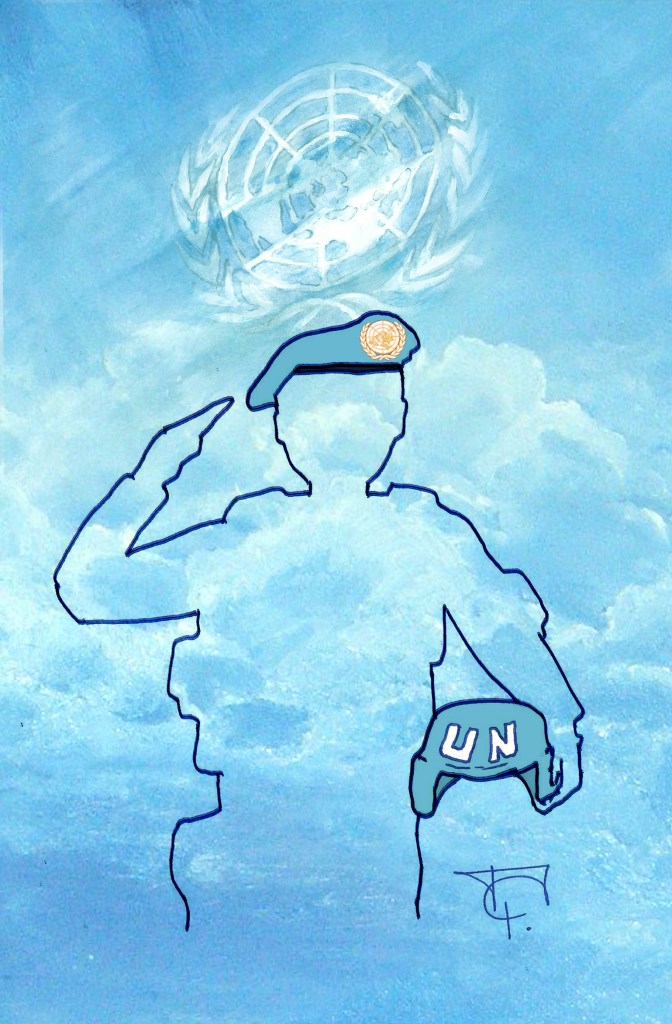
We honor our fallen comrades
MINUSMA has ensured that this attack will not undermine its determination to continue to fulfill its mandate. The UN mission also reiterated its continued commitment to protecting people and working for peace. The UN Secretary-General – António Guterres – reaffirmed the United Nations’ solidarity with the people and government of the Republic of Mali in their quest for peace, and offered his condolences to the Chadian government, as well as to the families of the dead soldiers of the peace, wishing a quick and complete recovery of the wounded.
Na passada sexta-feira 2 de abril de 2021, a missão das Nações Unidas para o Mali (MINUSMA) sofreu um “ataque complexo” (fogos diretos e indiretos coordenados na forma e no tempo), do qual resultou a morte de quatro capacetes do Chade. Os últimos reportes informam que, para além das mortes, existe também um número de feridos entre o contingente da ONU. Com este ataque já morreram no Mali 9 capacetes azuis desde o início de 2021, perfazendo um total de 245 soldados da paz mortos desde o início da missão em 2013.
We honor our fallen comrades
A MINUSMA garantiu que este ataque não prejudicará sua determinação de continuar cumprindo seu mandato. A missão da ONU também reiterou seu compromisso contínuo de proteger as populações e trabalhar pela paz.
O Secretário-Geral da ONU – António Guterres – reafirmou a solidariedade das Nações Unidas com o povo e o governo da República do Mali na sua busca pela paz, e ofereceu as suas condolências ao governo do Chade, bem como às famílias dos soldados mortos da paz, desejando a rápida e completa recuperação dos feridos.
A Organização do Tratado do Atlântico Norte acaba de divulgar as despesas militares (2020) de cada um dos 29 Aliados.
(Em milhões de unidades da moeda nacional) – Albania (Leks) 20,353; Belgium (Euros) 4,755; Bulgaria (Leva) 1,843; Canada (Canadian dollars) 30,815; Croatia (Kunas) 6,700; Czech Republic (Koruny) 74,300; Denmark (Kroner) 32,572; Estonia (Euros) 615; France (Euros) 46,200; Germany (Euros) 51,610; Greece (Euros) 4,398; Hungary (Forint) 853,196; Italy (Euros) 22,844; Latvia (Euros) 664; Lithuania (Euros) 1,028; Luxembourg (Euros) 356; Montenegro (Euros) 73; Netherlands (Euros) 11,500; North Macedonia (Denars) 8,303; Norway (Kroner) 67,908; Poland (Zlotys) 52,997; Portugal (Euros) 3,191; Romania (New Lei) 21,431; Slovak Republic (Euros) 1,796; Slovenia (Euros) 504; Spain (Euros) 12,932; Turkey (Liras) 89,392; United Kingdom (Pounds) 48,260; United States (US dollars) 784,952.
Nos muitos quadros e números disponíveis, pode-se ler que Portugal (embora tenha aumentado o investimento na área da Defesa) é o único país que não gastou praticamente nada em infraestruturas de defesa (0.2% do orçamento de Defesa), pertencendo ao grupo dos sete países que menos gasta em operações e treino militar (17.8% do orçamento de Defesa). A grande fatia do orçamento de Defesa continua a ser para os gastos com o pessoal (65.4%), colocando o país no grupo dos oito Aliados que gastam mais de 60% do seu orçamento de Defesa com o pessoal. Portugal volta a estar entre os sete países aliados que menos gasta em equipamento (16.6%).
Desta forma, parece obvio que para se manter qualidade e gastar menos com o pessoal e, simultaneamente, investir-se dinheiro em equipamento, infraestruturas, treino e operações, só há uma via a percorrer – aumentar o orçamento de Defesa para “os tais” 2% do PIB apregoado pela OTAN.
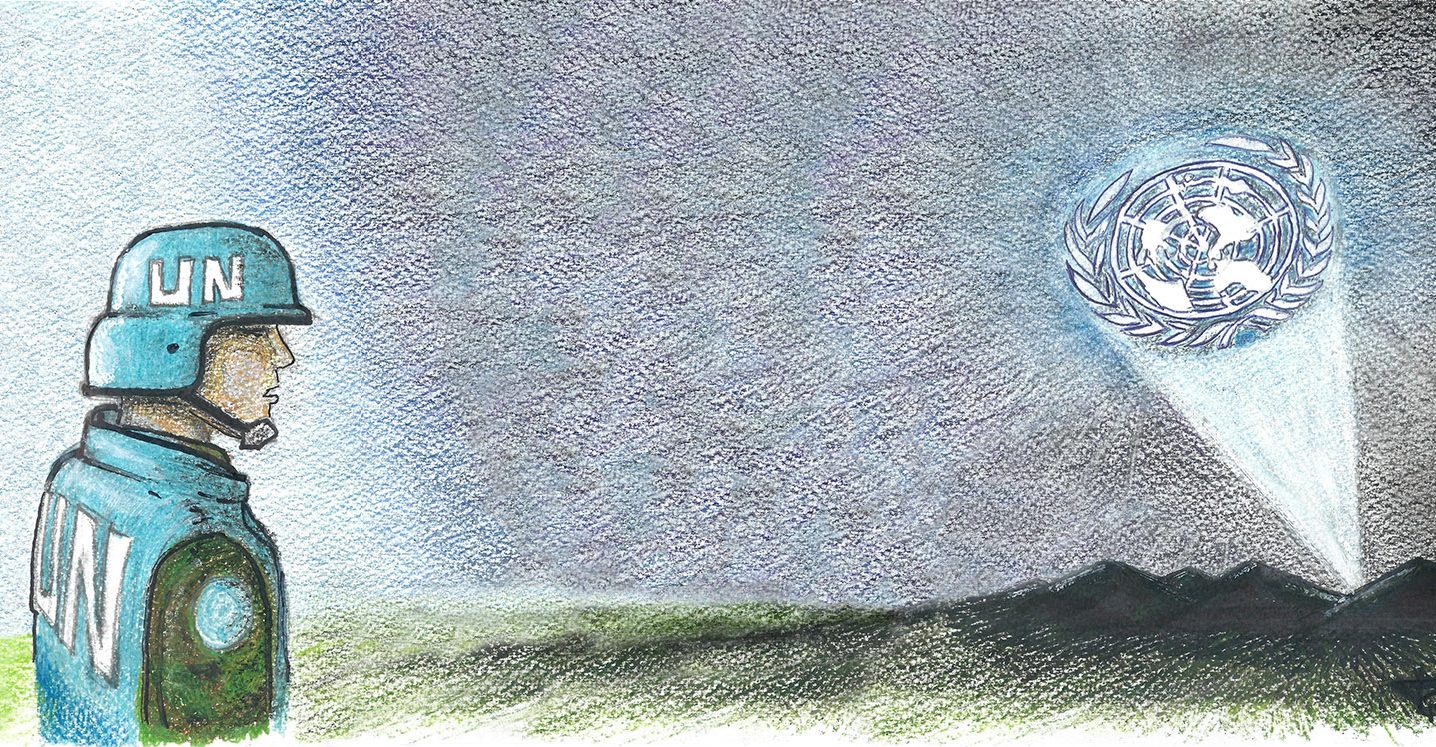
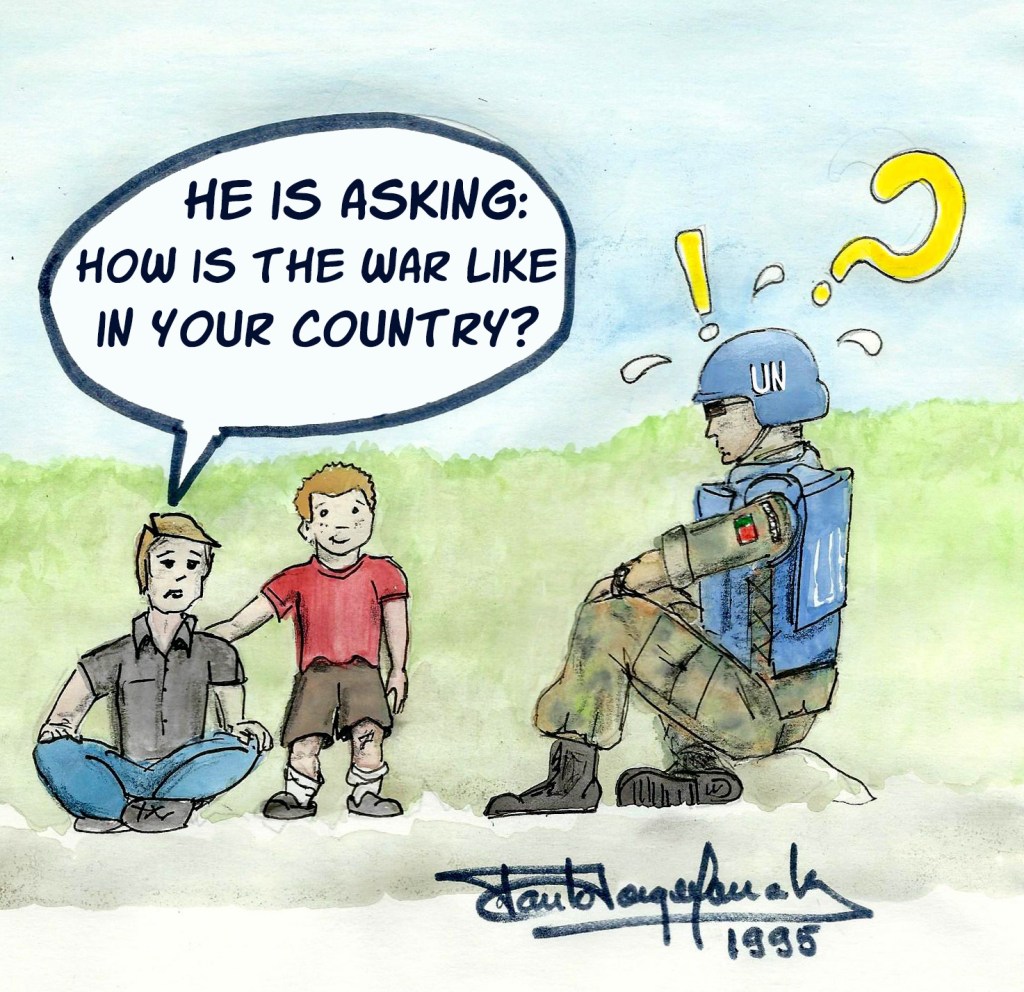
Our Veterans have wonderful stories…this story and illustration comes from one of our program participants from Portugal, Paulo Jorge Machado Dias Gonçalves:
“Nowadays, whenever I see children amusingly coming from school and playing on the streets, I smile and think how fortunate they are to live in a peaceful and secure environment.
As a peacekeeper Veteran, it’s inevitable to recall my UN mission during the war in Bosnia. One day, while patrolling Sarajevo’s streets, I saw some children playing hide and seek among the ruins of their village. That was the only possible game they could play out in the open, because there were snipers in the vicinity. When they saw that I was observing them they stopped playing. The youngest, recognizing that I was a foreigner soldier, approached me.
This child, who was about 5 years old, looked at me and with the most innocent smile, asked something I could not understand. A young man passing by translated it – “He’s asking how is the war in your country?”
What a punch in the stomach, to think that this was the only reality he knew… I often wonder if today’s parents realize that peace and security are not granted things. We all must strive to maintain them. We owe it to the next generations.” #Veteran #Artist
This story is currently being adapted to a musical and, coming soon, it will be available over the internet in a short (musical) video. Stay tune!
For several years we´ve been listening people claiming that the UN needs a serious restructuring. Many say that its peacekeeping missions are not actually solving the problems in the intervened territories, and the entire concept is in crisis. But, is it?
Peacekeeping is not only about military operations. It also deals with Human Rights; demining; electoral assistance; civilian protection, community welfare, and Rule of Law. All extremely relevant matters; and yet, considerable uncertainty surrounds the future of UN peacekeeping.
Peacekeeping missions are, by definition, temporary operations. The UN establishes an “End State” (the final goal, or objective, of the mission) and, upon arriving it, the mission should close. Having said that, some mission seems to be there forever, without a feasible sign of possible closing time. That´s due to the extremely difficult situations those host nations are suffering in the path from conflict to peace. Therefore, it must be seen as an investment and not an expenditure, because the peacekeepers operate in territories where other people cannot.
Presently, the UN has approximately 90,000 military and police blue helmets from 122 different countries, integrated with civilian staff, in 12 missions around the World. The UN peacekeeping yearly budget is 7,3 billion US Dollars. Although that sum seems to be a huge amount of money, it is only 0,5% of the 1.5 trillion US Dollars the World spends each year in warfare. Each year, the United States of America deploys more military personnel abroad than the United Nations.
It is consensual that the UN structure and modus operandi needs reviewing, because it was set for the post Second World War environment, but “the times, they are a-changin’ ”. It needs a metamorphosis.
The UN has got to become lighter, faster and wider in its intercentions; but we do need it!
Many say that the number of seats in the permanent board of the United Nations’ Security Council should be enlarged from the current five (China, France, Russia, United Kingdom and United States) to 12 and above. Others say that the real problem resides on the “veto” prerogative that the five permanent nations have, and that it should be deleted from the UN Charter. The “veto” tool is (too) regularly used which blocks all major decisions and prevents conflict resolution where their interests are at stake. France and the UK have proposed that the “veto” prerogative should only be used scarcely, under specific conditions that might affect directly and profoundly that nation security. This is an interesting proposal, because it does not require any changes in the UN Charter, or other legislation, been exclusively a political agreement among the five permanent nations. The proposal is under study and appreciation and its approval or refusal could make a considerable difference in the way peacekeeping operations will be done in the future.
The UN Secretary-General – Antonio Guterres – has a project called: the “Future of Peacekeeping”, aiming to anticipate how peace operations might look like. In the last few years, there’s been a 24% reduction in peacekeeping personnel and a 23% reduction in spending. From 2017 further reduction in peacekeeping missions has occurred, and several peacekeeping missions have been closed. Secretary-General Guterres prefers focusing on preventive initiatives and special political and peacebuilding missions with “light footprints.”
A major reason for this new posture is the financial pressure that the major contributors have put over the UN. The United States under former president Trump and some European countries have sought drastic cost reductions, which the impact of the COVID-19 pandemic is likely to intensify. However, one should look to the overall landscape of the peacekeeping operations because, despite a range of current constraints, challenges, and crises, UN peace operations are unlikely to finish, but rather to evolve, because:
1 – The World we live in is becoming an evermore a common space, both in all its successes and (mostly) in all its crisis. Stock markets, organized crime, desperate migrants, radical ideologists and pandemics do not stop at our country’s physical borders; therefore, isolationism is not the way to go.
2 – The problems that the UN is trying to solve do not seem to diminish in the future and, sooner than latter those problems will spill over into the rich countries, jeopardizing their social structure and economy. It is much safer, and cheaper, to solve those problems at the origin, with a UN mandate, than it is to suffer the consequences of a “homeland solution”.
3 – UN peacekeeping missions work! Some may work faster than others, but they do work. Its absence would imply a significantly higher death rate and problem solving, among the supported populations, than it is with UN “boots on the ground”.
4 – UN peace operations are highly cost-effective both as investments for conflict management and in terms of deployment costs. UN member states are unlikely to reject them indefinitely, though peace operations might become less frequent and more constrained in the absence of great power cooperation;
5 – Peace operations remain a potentially useful tool for great powers to manage a wide range of conflicts with international political coverage and public opinion acceptance.
In conclusion, it is true that the UN needs, and will have to, restructure itself in order to adjust to the new World challenges. It must be lighter in its structure, faster in its action and wider in its intervention space. But there is no reason for great powers to abolish peace operations, quite the opposite, they need it to prevail in order to legitimize their problems’ solutions. Hence, there’s no evidence that the United Nations, or its peacekeeping missions, are crisis.
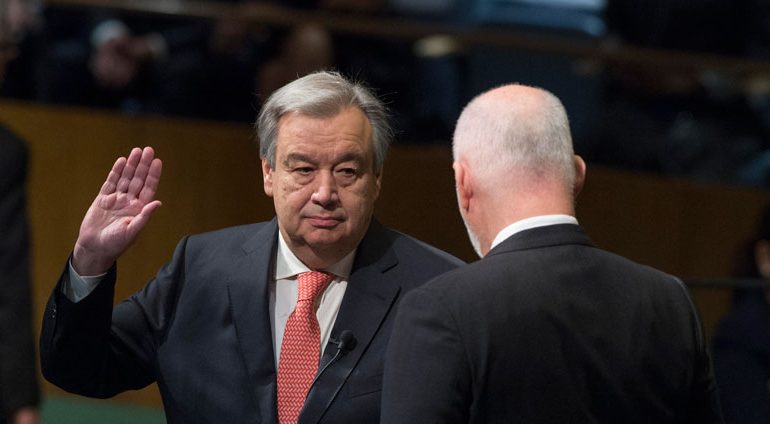
The Portuguese Prime Minister stated that Portugal formally supports the re-application of António Gueterres to the next turn of Secretary-General of the United Nations, starting in January 2022, for five more years. Thus the Portuguese Government will therefore send a letter to the Presidency of the Security Council and the Presidency of the UN General Assembly.
UN photo
Global climate, the Oceans, COVID 19 Pandemic, World’s Peace and Stability and the reform of the United Nations are the major fields Guterres is expected to deal will during his upcoming mandate.
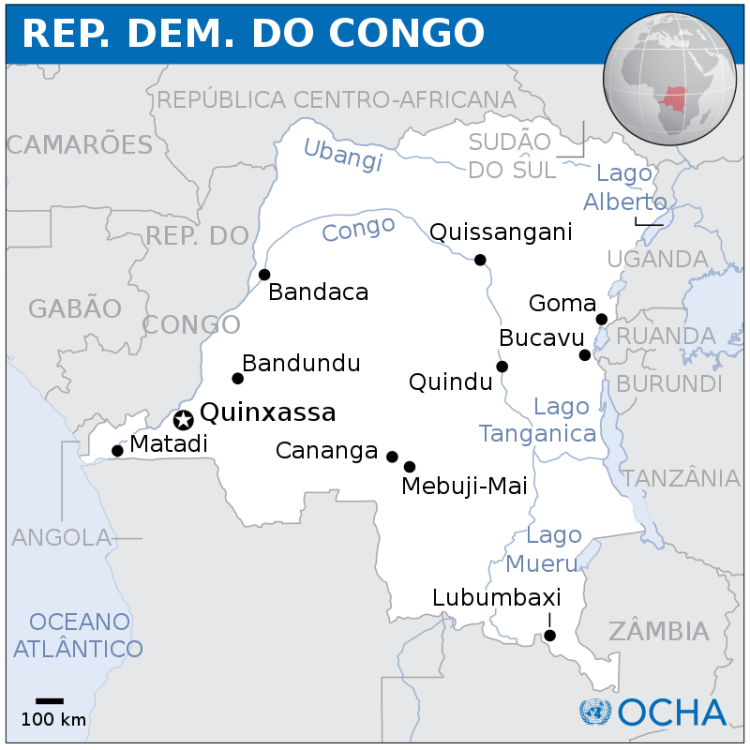
On February 22, the Italian Ambassador to the Democratic Republic of Congo – Luca Attanasio – his security guard (Carabinieri) – Vittorio Iacovacci – and his driver – Mustapha Milambo – a Congolese contracted locally, were brutally murdered about 20 km from Goma, in the East DRC. The site is within Virunga National Park, on the border between DRC, Rwanda and Uganda, and where several armed rebel groups operate.
The Ambassador’s car was travelling embedded in a convoy of vehicles from the United Nations’ World Food Program, with the aim of visiting and supporting the humanitarian aid activities that were being provided to needy populations in the region. During the attack, the terrorists also kidnapped four other people, one of whom, meanwhile, was found by Congolese security forces.
The Congolese authorities were quick to accuse the Rwandan Hutu rebels of the Democratic Liberation Forces of Rwanda (DLFR) of being behind the attack. However, Rwandan DLFR rebels deny responsibility. However, allegedly there´s a jihadist group, close to a terrorist faction that has been perpetrating massacres in northern Mozambique and Tanzania, that claimed the attack. These Jihadists claim that they carried out the attack with a small commando group of six men, using only with Kalashnikov rifles. According to sources, this group of jihadists is trying to capitalize on the success of the attack on the United Nations convoy and it’s calling for more attacks on diplomats in the region.
The UN has about 15,000 military personnel in the country, serving on the MONUSCO peacekeeping mission. After the attack, the area was patrolled by Moroccan blue helmets but, so far, the 3 missing people who have been kidnapped have not yet been found. MONUSCO is currently one of the largest and most dangerous operations in the UN.
We express our condolences to the families of the deceased, our sympathy to the international community in the DRC and Italy, and we wish the speedy recovery of those who are missing.
No dia 22 de fevereiro o Embaixador Italiano para a República Democrática do Congo – Luca Attanasio – o seu segurança (Carabinieri) – Vittorio Iacovacci – e o seu condutor – Mustapha Milambo – um congolense contratado localmente, foram brutalmente assassinados a cerca de 20kms de Goma, no Leste da RDC. O local está dentro do Parque Nacional da Virunga, na fronteira entre a RDCongo, o Ruanda e o Uganda, e onde operam vários grupos armados.
O Embaixador seguia numa coluna de veículos do Programa Alimentar Mundial, das Nações Unidas, com o objetivo de visitar e apoiar as atividades de ajuda humanitária que estava a ser providenciada a populações necessitadas da região. Os atacantes raptaram ainda quatro outras pessoas, tendo uma delas sido, entretanto, encontrada pelas forças de segurança congolenses.
As autoridades congolenses apresaram-se a acusar os rebeldes hutus ruandeses das Forças Democráticas de Libertação do Ruanda (FDLR) de estarem por detrás do ataque. Porém, os rebeldes ruandeses da FDLR negam a responsabilidade. Por outro lado, alegadamente um grupo jihadista, próximo do da fação que tem vindo a perpetrar massacres no norte de Moçambique e na Tanzânia, reclamou o ato, praticado por um pequeno comando de seis homens com Kalashnikov. Segundo fontes, esse grupo de jihadistas exorta o sucesso do ataque às Nações Unidas e apela para que se façam mais ataques a diplomatas na região.
A ONU tem cerca de 15.000 militares no país, servindo na missão de peacekeeping MONUSCO. Após o ataque a zona em questão foi imediatamente patrulhada por capacetes azuis de Marrocos, mas, até ao momento, ainda não foram encontradas as 3 pessoas que foram raptadas. A MONUSCO é atualmente uma das maiores e mais perigosas operações da UN.
Apresentamos as nossas condolências às famílias dos falecidos, à comunidade internacional na RDC e a Itália, e desejamos a rápida recuperação daqueles que estão desaparecidos.
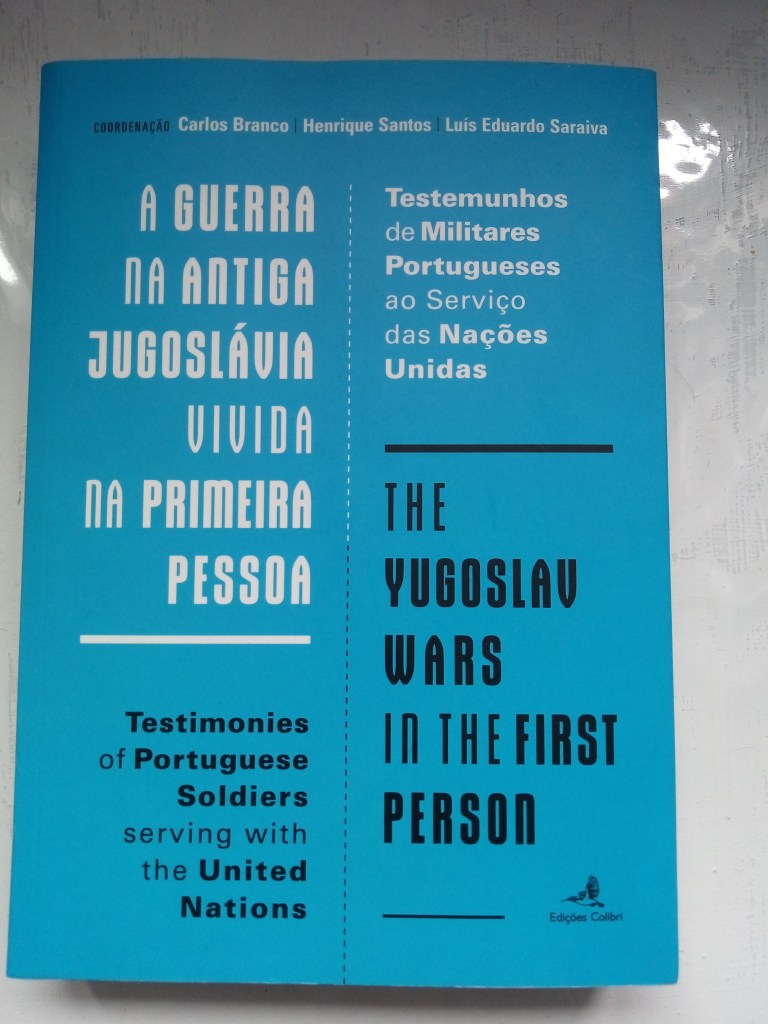
A Força de Proteção das Nações Unidas (FORPRONU) foi a primeira missão das Nações Unidas na antiga Jugoslávia durante o desmembramento do país. A força foi estabelecida em fevereiro de 1992 e o seu mandato terminou em dezembro de 1995. Foi composta por cerca de 40.000 militares (incluindo 680 Observadores Militares) e civis oriundos de 37 países, o que a tornou à data a maior operação de manutenção de paz da história das Nações Unidas.
Ironicamente, a “experiência jugoslava” foi uma janela para o mundo; um “Erasmus da vida” que tornou os que nela participaram pessoas cosmopolitas. Foi um abrir de olhos. Relacionaram-se tolerantemente com indivíduos de origens e culturas que não conheciam. Foi o confronto com um mundo novo, “para além da Taprobana”. Mais que uma escola da vida, a “experiência jugoslava” foi uma escola de camaradagem. Fez com que vivências moldadas pela adversidade se tornassem laços intensos de amizade, que perduraram até aos dias de hoje. Este livro serve para preservar a memória, um elixir contra o esquecimento, para que as gerações vindouras saibam um pouco melhor o que ali se passou; para vincar a satisfação da missão cumprida; para honrar o companheirismo, a amizade e o espírito de sacrifício. E não é pouco.
The United Nations Protection Force (UNPROFOR) was the first United Nations peacekeeping mission in the former Yugoslavia, during the breakup of the country. The force was established in February 1992 and its mandate ended in December 1995. It was composed by almost 40.000 military (including 680 military observers) and civilian personnel, from 37 countries, which made it at the time the largest peacekeeping operation in the history of the United Nations. This book aims at preserving memory. It is an elixir against oblivion. So that the generations to come will know a little better about what happened there; to underline the satisfaction of mission accomplished; to honour companionship, friendship and spirit of sacrifice. And it is no small matter.


 OPen samento