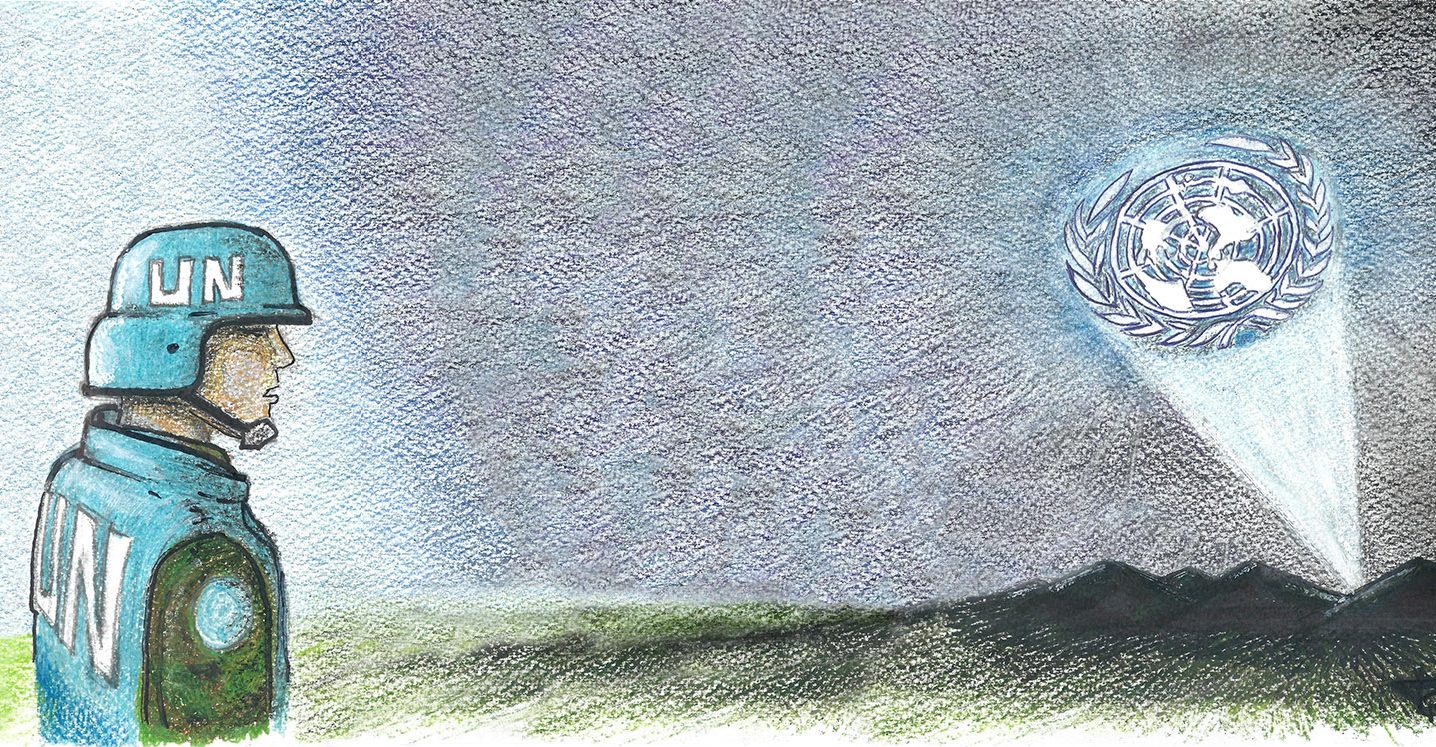
At the very beginning of the United Nations Organization, there was a need to establish all sort of rules and criteria, which would reflect the organization’s DNA. There was the need to create a UN symbology, and that matter was not underplayed, because the founders of the organization were perfectly aware that the UN soldiers had to be promptly recognized, if they wanted to survive the vicious battle field they were going to operate at.
In 1947, UN’s General Assembly issued the Resolution 167 (II), approving the color light blue (of a sky with clouds) for the United Nations flag. Thus, the light blue came to represent the UN.
The culture of military uniforms was very much present in the post-World War II era and, soon after, the creation of a uniform for the elements that were in the service of the UN was taken into consideration.
Subsequently, in 1948, a contingent of UN Military Observers was sent to the Middle East to oversee the truce of the Israeli-Arab conflict. These Military Observers wore roughly the same type of tactic uniform, and received some articles to stick on their uniform, that reflected the fact that they were members of the United Nations. Besides and individual armband saying United Nations, the Observers carried a UN flags; and had their vehicles painted white with large ‘UN’ black letters painted on the side doors and on top of the vehicles. This particular way to paint the UN vehicles has become the current practice in all subsequent UN peacekeeping missions “
In 1956, the UN established an Emergency Force to oversee problems in the Suez Canal (UNEF). This was the first UN peacekeeping operation. Troops from different countries wore their national uniforms and added UN emblems and arm bands. To be better identified at a distance, they wore a blue beret and had their helmets painted in light blue, like the UN flag. These unique pieces, which came to be called “Blue Helmets”, were created by the Organization’s Secretary-General – Hammarskjöld – during the days that corresponded to the creation of the UNEF force “.
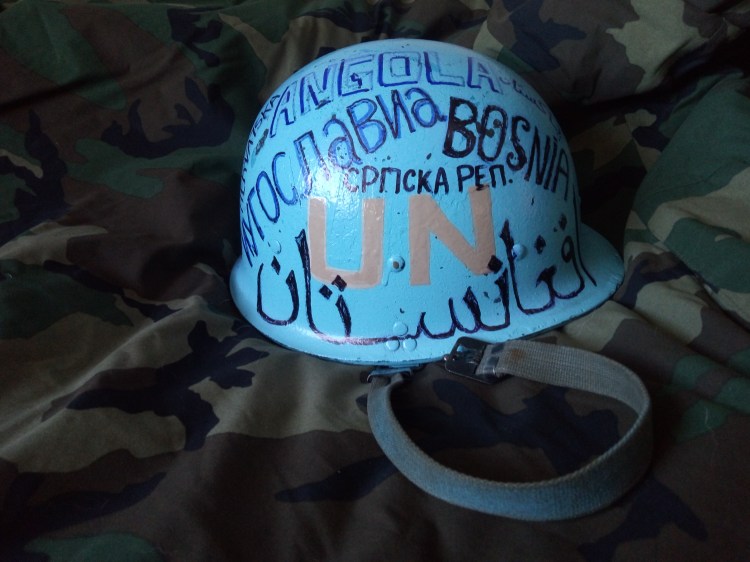
According to the recently deceased Sir Brian Edward Urquhart (writer and head of the UN policy sector): “What was needed was a distinct helmet easy to be recognized by a distant sniper. A blue UN beret seemed to be the answer, but it was impossible to get enough berets in time. American plastic helmets, however, were available in quantity in Europe, resulting from the Cold War, and were quickly painted with UN blue spray, just in time for the first UNEF detachments to use in their entry into Egypt “(Urquhart, p. 269).
And this was how the first Blue Helmets come to be.
 OPen samento