When analyzing the war in the former Yugoslavia, there’s a point that always comes highlighted:
- There were weapons everywhere, some of it of a highly sophistication.
One can’t help asking, where did all those weapons come from?!
Marshal Tito had created the Socialist Federal Republic of Yugoslavia (SFRY), under the spectrum of the Cold War. In those times, SFRY was notably the fifth military power in Europe. Tito refused to be a puppet of the Soviet Union but, at the same time, did not wish to upset the Kremlin by becoming a NATO member; therefore, he optioned for SFRY to be a “non-aligned” country. Not being part of a military block and laying on the geographic frontier between NATO and the Warsaw Pact, Tito considered all his neighbouring countries (Bulgaria, Romania, Italy, Greece, Austria, Hungary and Albania) as potential aggressors. Allegedly, Marshal Tito used to joke, saying that Yugoslavia was surrounded by BRIGAMA (the M stands for Hungary, which is pronounced Madjarska in Serbo-Croatian language). The word “brigama”, in Serbo-Croatian, means “troubles”.
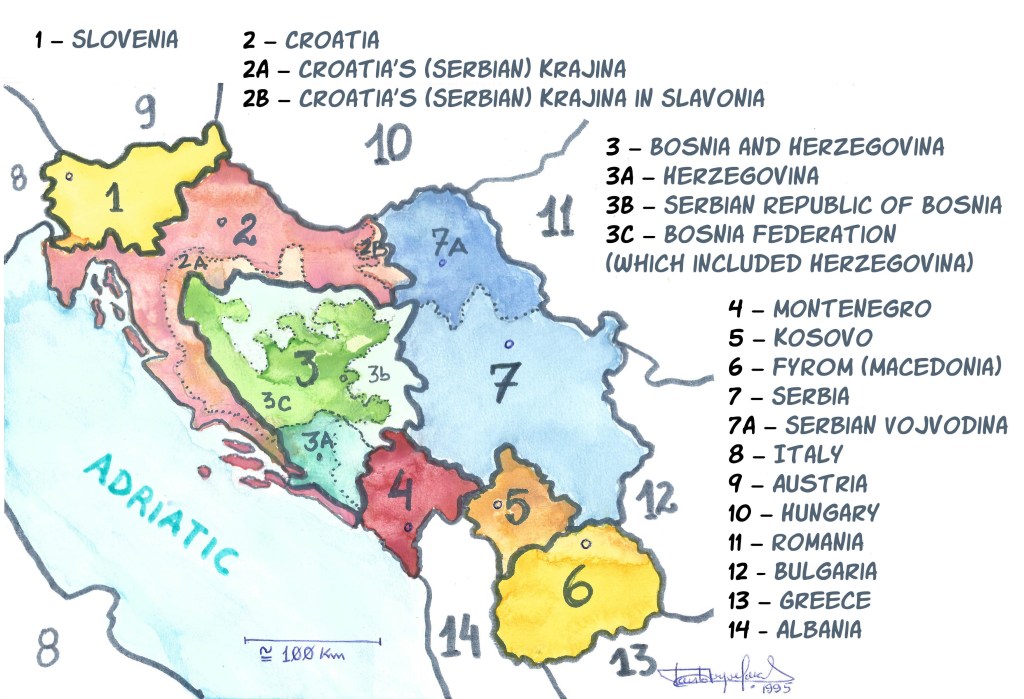
Consequently, Tito took preventive measures and transformed his Yugoslavia into a fortress, with the population trained and ready for war. Every major public investment had a military use. The houses had to have basements (to be used as bunkers), the factories had arsenal rooms where the (trained) workers could collect weapons to respond immediately to a surprise attack; the highways could be transformed into airfields; etc. Even the kids, at school, were trained to react and support the military effort, in a (militarized) type of Scout’s organization. It was a pure “Cold War” posture, aiming to protect one of the greatest countries in Europe.
With such a proliferation of weapons, it shouldn’t come as a surprise that the political conflict between the three ethnic parties could rapidly raise to an armed confrontation. And so it did!
#Bosnia #UN #War #UNPROFOR #Peacekeeping #peacekeepinginawarzone
 OPen samento