On this Peacekeepers’ Day 2020, I inform that during next week I will make available my new ebook about UNPROFOR. It will be an online version, and I will post the proper link shortly. For now, I offer you an extract of one Chapter (Operation Flash). the eBook has 22 chapters, over 500 pages and 110 images. I aim to contribute in the preservation of the UN missions’ memories, and I hope you’ll enjoy it.

…../ page 151 of 517 pages/ …
On 1st of May 1995 – Labour Day – at exactly 05:30, an UN Military Observers (UNMO) car crossed Zagreb HQ’s main gate inbound Belgrade. Inside the vehicle were two Captains – Alex the Portuguese and Dave the New Zealander. They were returning from Croatia do Yugoslavia (their deployment location) after having dropped in Zagreb another Captain from Finland (Asko) which had finished his mission in UNPROFOR.
It was a bright day, with clear blue skies, just like the day before. Alex had the steering wheel and Dave was sleeping on the back seat. There was no way Alex could miss his route; he just had to follow the opposite path of the previous day.
The first thing Alex noticed was that, in Yugoslavia the highway had signs indicating directions to Zagreb, but on the return trajectory of the Croatian highway (A3) the signs never mentioned Belgrade. The end location pointed was Lipovac, although inside the Serbian Krajina, that was the last Croatian City before the border.
A short distance after they had passed the oil fields Pump-jacks, still close to Zagreb, the highway was closed to civilian vehicles. Alex slowed down and gently overtook a gymkhana made of road cone pins. A pair of Croatian policemen stood in the middle of the highway and Alex stopped to salute them. The guards appeared to hesitate and signalled Alex to move without further questions; probably because they didn’t have enough English to ask any questions.
There was no traffic whatsoever in both directions, therefore Alex took the Toyota SUV to its speed limits. Dave was snoring on the back seat, all the windows were closed due to the speed, and the vehicle’s tape recorder was playing a nice soft music. It seemed like it was going to be a nice three-and-a-half-hour trip, having only to deal with the checkpoints’ bureaucracy.
At a certain stage, in between two songs, Alex seemed to have heard a strange distanced stuffed sound. He reduced the speed of the SUV, turned off the tape recorder and opened his window. There were definitively strange resonances out there; it sounded like the hiccups of a giant. As they were arriving to the vicinities of Sector West, Alex woke Dave up.
Suddenly, a UN ambulance flashed-by in the opposite direction, with all its emergency signs on. The sounds were now perfectly clear; there were explosions occurring up ahead inside Sector West. As the two UNMO were trying to understand what was happening, and the vehicle approached a highway bridge, they encountered a Croatian Special Police checkpoint. Strangely, there was no gymkhana, no sandbags and no barbed wire. That was a recent checkpoint, with policemen armed to their teeth, with top quality individual combat gear, eager to engage. The quality of the Croatian equipment shouldn’t come as a surprise for the two UNMO officers, because it was well known that the Croats had the most recent equipment, which left few doubts about international support to their cause; and, again, the disrespect of the UN arms embargo imposed on all belligerents.
The Croatian policemen ordered the car to stop and Alex complied promptly. Dave opened the door and moved towards the guards, trying to understand what was happening. About one kilometre to their right, in Subocka village, artillery guns were firing in the direction of Sector West.
– “Jesus!” – Exclaimed Alex. – “The Croats are attacking the Serbs and we’re in the middle of the battle!”
Dave tried to explain that they were UN staff and they should be allowed to pass. However, the senior policeman didn’t want Military Observers around and made it very clear gesturing aggressively for the two UNMO to move back to Zagreb. In 1995 it was easier to find a middle-aged Croat speaking German than English; hence Dave didn’t have success in his attempt to convince the policeman. In fact, insisting on the matter was only making the Croats unreasonable, and that was not good; especially in that situation.
From the other side of the highway, camouflaged among bushes and trees, a Multiple Rocket Launcher started to fire its missiles. Everybody was caught by surprise and instinctively frightened; including the Croats. The 12 explosions of the firing system were followed by the sound of big rockets flying right over their heads. It sounded like someone had sequentially ripped apart 12 bed sheets; using the sound system of a rock band.
– “You go Zagreb. GO NOW!” – Yelled the policeman, unholstering his pistol.
It was time to go, definitively; Dave got in the car and said:
– “Alex, let’s get out of here because we don’t want to be around when the Serbs retaliate … and they will retaliate!”
Alex turned the car around against the traffic flow direction (although there was no traffic) and moved away rapidly back to Zagreb, cursing the damn the car for having no UN communications’ radio.
Their adrenaline had reached a peak and Dave jumped to the back of the SUV looking for their helmets and flak jackets, in order for them to wear some body armour … just in case!
After a few kilometres down the highway, already out of visual range from the police checkpoint, they stopped and got out of the car. Alex complied with the warzone procedure and kept the engine running. They dressed their bulletproof vests while taking notes of what they were witnessing. In these situations, small details are important but they tend to disappear from the soldiers memory if notes are not taken at the spot. What they were experiencing was the real essence of a UN Military Observer’s job. Either in the radar room or out on the fields, they observed, assessed and reported.
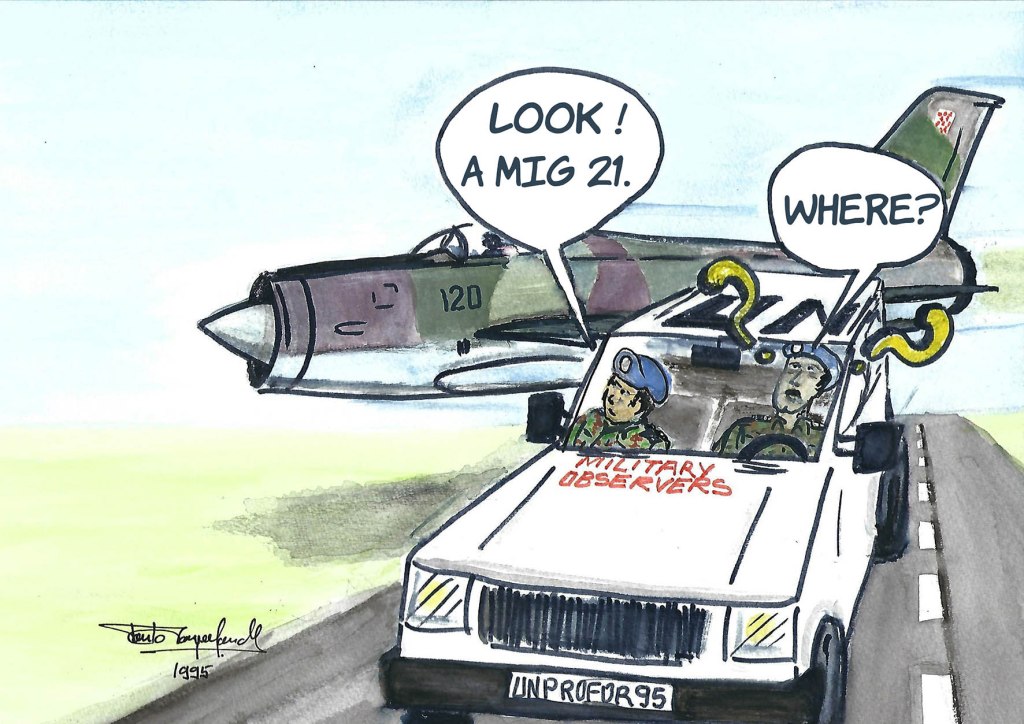
Unexpectedly, two MIG-21 jet fighters flew by, just above the tree’s canopies, screaming like possessed demons. They were carrying deliverable weapons under their wings, straight into Sector West. The turbines’ noise was so strident that Alex had to yell:
– “GOD DAMN IT! HOW CAN WE SEE THESE GUYS ON THE RADAR IF THEY’RE FLYING AT THESE ALTITUDES?”
– “MATE … THESE ARE NOT ALTITUDES … THESE AIR HEIGHTS ABOVE THE NEXT STONE ON THE GROUND.” – yelled Dave, trying to follow the aircraft through the vehicles window. – “IT’S LIKE IN THE HELICOPTERS … NAP FLIGHT … ONLY FASTER … MUCH FASTER.”
The MIGs were flying so low that the Airfield Monitors used to say that those pilots didn’t need wings; because they were “driving” those aircraft at the same altitude of the cars.
The two UNMO were at no more than five or six kilometres from the police checkpoint where they were ordered back. The sounds of the battle got stronger and stronger. Up in the sky, they could hear an internal combustion small engine, probably an ultra-light aircraft, or a drone, guiding the fire accuracy of the Croatian artillery.
– “That’s an ISR (Intelligence, Surveillance and Recognition) flight. Something to take into consideration when you guys are instructed to drop small radar contacts, moving too slow, for a long time, over the same location.” – said Dave blinking his left eye, in rapport to the recent ICFY inspection.
Occasionally, the wind brought distant reverberation of rotor blades. According to those sounds, there were helicopters performing demanding manoeuvres, no more than three kilometres away. Alex could distinguish the speedy drumming of the blades becoming a heavy flapping of the rotor, putting “G” forces on both crews and machines.
Over to their right side, behind a concentration of pine trees, they could hear metallic sounds of heavy vehicles moving over endless metal chains.
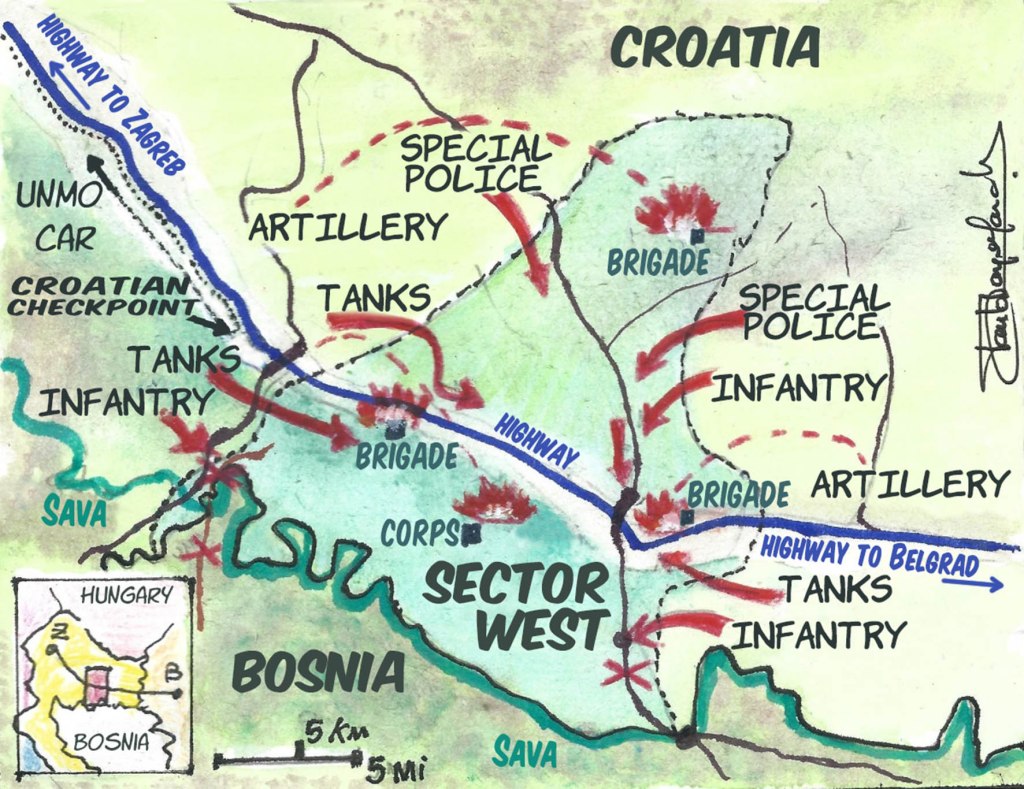
– “Tanks! Those are tank track noises.” – said Dave apprehensively. – “If there are tanks here, the infantry is close behind! This is not a small thing Alex, this is a Croat joint attack to Sector West. They are coordinating artillery, aviation, armour cavalry, infantry and special police; all together … this time the Serbs are doomed.”
From a distance, they could also hear the distinct slow rhythmic sound of heavy machine guns; probably a few entrenched Serbian soldiers trying to stop the Croat massive advance.
The roar of the cannons got louder and constant, as if it was the last moments of a firework show. The two UNMO officers were literally reading the war through its sounds. The Multiple rocket launchers fired again their 12 sequential missiles.
– “I assume those were 128 mm MRL (Multiple Rocket Launchers).” – Said Alex remembering the indoctrination course and the small booklet distributed with Yugoslav weaponry.
– “Yap! Those are M-63 Plamen.” – completed Dave smiling, out of his experience from Krajina where he had been posted before coming to Belgrade. – “No worries mate, you’ll get to see it in action to. Some of us; like me; get to see it at the start of the mission, others; like you; get to see it at the end. But we all get to see it!”
Dave’s prophesies, about Alex going to Bosnia on his second mission semester, was not exactly what Alex needed to hear; especially because Dave was normally right.
The time seemed to run very slow, but all the events the two UNMO were witnessing took no more than four or five minutes. They were standing in the middle of the highway, listening to the developing attack with the car’s engine running, when the stuffed spasm of an explosion occurred not far from their position.
The canopy of the trees bordering the highway balanced with the shock wave and there was a rain of dirt and little stones falling around the two UNMO.
– “INCOMING.” – shouted Dave with all his body. – “I TOLD YOU THE SERBS WOULD RETALIATE! LET’S GET THE HELL OUT OF HERE!”
They both dived into the car and Alex accelerated making for distance between them and the impact zone. There was another explosion on the fields next to the highway, so close that the car shock with the blast wave. Alex was practically standing on the accelerator pedal, heading to Zagreb.
Some more kilometres ahead, already out of the close danger area, they saw another UN vehicle driving on the same lane but on the opposite (correct) direction. Alex gave them light signs to stop and both vehicles stopped side by side for the occupants to talk. Driving the other UN vehicle was a Russian Colonel, with a Jordanian officer quietly seated on the back seat with an apathetic semblance. The two UNMO tried to explain what they saw, but the Russian Colonel knew all about it. The officer in the back seat was the accompanying officer of the three wounded Jordanian soldiers travelling in the ambulance they had seen earlier that morning. Those blue helmets were the first casualties produced by the Croatian attack … not Serbs.
The two UNMO tried their best to convince the Russian Colonel not to proceed to Sector West, but he simply said he had his way to convince the Croatian Police to let him through.
Out in a distance, they saw a Croatian patrol car approaching, and both UN drivers decided to move ahead; Alex to Zagreb and the Russian Colonel to Krajina.
There was a saying in UNPROFOR, trying to define the quietness of Sector West: – “Sector West is Rest” – but apparently, not anymore. In fact, the way things were developing there would no more Sector West in a short time. About half an hour before reaching Zagreb, with the Capital’s tall buildings in sight, the sounds of the battle could still be heard.
The elapsed time between Alex and Dave having left Zagreb’s HQ and entering back into the compound was about two hours. Meanwhile, the Croatian tanks moved in and ……
….
…
… 2nd May 1995, 07:30, Alex and Dave were back in the briefing room of the UNMO HQ in Zagreb, together with the Dal team UNMO crew. They were eager to know how the situation had evolved during the night, in order to see if they could return to Belgrade; by land or by air. The air solution was, again, out of the question. Maybe Airlines had all its assets grounded for maintenance.
Suddenly, screaming sirens all over Zagreb alerted the population to take cover.
– “AIR RAID.” – Someone yelled in the room. – “Everybody dress-up in your flak jackets, put on your helmet and rush to the building’s basement.
Out in the streets of the City, it looked like a scene from the Second World War. Every neighbourhood had a siren connected to the next neighbourhood. When the alert system was activated, they all started an alarming howling chorus, like a large pack of wolves. The UN staff was used to seeing it on Hollywood movies, but the live version had no comparison what-so-ever! It was terrifying.
People were shocked; that was Zagreb; a Central European Capital; a large urban area with 1.700 square kilometres and a population of almost one million souls; and the year was 1995. It was not only panicking, it was surreal. Zagreb was under air attack!
… the TV was passing CNN “breaking news” and the reporter was saying that Zagreb had just been hit by a barrage of several missiles, showing burning vehicles in the streets of the Capital. That news report totally discredited those UNMO’s assessment, which irritated the Colonel.
Turning to Alex and Dave, the Colonel said:
– “Definitely, you two are not going anywhere until this is over! … … I need someone able to distinguish a car bomb from an air raid; and I have all my staff engaged with some other urgencies at this moment. I’m assigning you two the mission to go out there and get some credible stuff. … … this metallic piece (shrapnel) has just arrived from Zagreb Airport area … Pleso. Guess what!? It landed close to the airport and it was not an aircraft. It’s a piece of a freaking missile! Take an interpreter and come back with something useful … today.”
…
… The rural area around the Airport had a set of isolated single family houses, adjacent to the agriculture fields. In a radius of no more than 100 meters of what would be the first missile impact all the houses’ roofs were damaged, with large portions of roof tiles missing. The glasses on the windows were broken and, in the pavement, there were small blast craters. The size of the crater depended on the type of pavement but, in the dirt roads it had about 30 centimetres of diameter and 10 centimetres deepness. By the look of it, the explosives seemed to be not very powerful, but the concentration of craters and unexploded devices was impressive. Those might have not been very powerful explosives, but they were extremely dangerous if used in such high concentration over a populated area.
Bombing Zagreb with Cluster Missiles was material for War Crime consideration.
– “Those holes are from the explosions of the bomblets that came inside the missile.” – Explained the police agent. – “The Orkan is a large rocket, it carries about 200 bomblets. I will show you now where the three Orkans fell.”
…
– “UXO;” – explained the escort policeman. – “those are Unexploded Ordinances – UXO – do not touch them. Be very careful with the fabric strips. When the bomblet leaves the Orkan, the air makes attrition on the fabric strip, and it starts to unfold. When the strip is fully unfolded it arms the explosive A simple touch on it and it will activate an explosion. We are waiting for the Police EOD (Explosive Ordinance Disposal) Team to arrive and handle all those UXO.
Come; I will show you the Serbian Orkans.”
Meanwhile, they distantly heard again, the chorus of sirens announcing yet another air raid over Zagreb.
The MIG-21 fighters were back in the air, taking off at a short distance from their location, using a great deal of deafening jet power. The “Fishbed” (NATO code name for MIG-21) were still taking off from Pleso International Airport, straight to Sector West. That could only mean that the combats were still ongoing, more than 30 hours after Operation Flash had started.
…
… The report was received with appreciation by the leadership. A total of seven Orkans had fallen over Zagreb: one in a school playground; three in the commercial area downtown; and three in Pleso. Only in Pleso they were able to reach accurate conclusions, because the missiles that had fallen in the middle of urbanized area had their trajectory twisted by impacting with the buildings.
…
– “Congrats gentlemen; that was a good report.” – Said the Colonel. – “Make the necessary arrangements with Dal Team and go home! You still have the entire afternoon to do it, and the days are getting longer. Thank you for everything.”
…
The plan was to contour the northern part of Croatia, using country roads, thus avoiding Sector West and entering Sector East in the vicinities of Osiek.

… Operation Flash was still ongoing in northern Croatia. The roads were packed with long convoys of all sorts of supporting vehicles. The Croat youth had been mobilized and there were plenty of volunteers to fight, or to support the combat logistics.
While there was day light, the UN staff was able to appreciate the beautiful northern Croatian landscape, which was normally out of the touristic programs, hence hidden to the outsiders’ eyes. They crossed amazing forests, where wild life still existed. There were dark shadows among the concentration of Nordic pine trees, resembling the old tales about bewitched woods. They drove as fast as they could, but the traffic was much heavier than they had planned.
At a certain point they fell behind a convoy of big trucks and cargo vans, moving towards the rear of the Croat attack. It was an amalgamation of military and civilian transporters of all types and origins. All those vehicles, like the UNMO small convoy, were trying to go around the confrontation zone and reach the Croat rear, where the tanks were waiting to be refuelled and rearmed. The “scissor” manoeuvre around Sector West was about to be completed, but it required urgent logistic replenishment, and most of the ammunitions, fuel and food, were travelling in that logistic convoy.
In 1995, a Croat tank could easily consume five litters of fuel per kilometre, and they had many tanks, preparing to run many kilometres in the final offensive on the next morning. They were desperately waiting for that logistic support. Meanwhile, the logisticians also had to feed the soldiers and take care of the wounded and the dead.
…
… that was nothing compared with the work that those Croatian Army logisticians must have had. They faced the challenge to identify ahead all the needs and requirements of the fighting soldier; from an extra clip of bullets in the frontline, to the roll of toilet paper in the rear. Furthermore, the Croatian Army did not have enough organic logistic assets to engage in such an operation. They had to rent civilian trucks and drivers from a variety of origins – many of them foreigners – have them load their cargo in different specific places, and “magically” organize a flow of land transporters, from all different directions, in order to have “item X” delivered to “Unit Y”, located in “position Z”, at “H” hours of day “D” … that was more than science; it was “art”. The people that witnessed that manoeuvre understood the military saying:
– “In a battle, amateurs talk about tactics, but professionals discuss logistics.”
Suddenly the logistic convoy turned right on a dirt road into the forest, heading southeast, leaving the main road free for the UN vehicles to accelerate eastbound. Daylight was fading out rapidly and a moonless night started to cloak everything.
They were driving for some hours when gradually the roads became bumpy due to deep scratches on the pavement produced by tank tracks and mortar grenade impacts. They were approaching Sector East. The UNMO vehicles crossed villages where not even the darkness could hide the destruction of recent years’ warfare. Smashed and burned-out vehicles were lying down in the accesses of shattered houses. Roads and streets’ edges had white crosses marking suffering and death spots; there were so many of them that it could only pass unnoticed if considered its regularity.
Tired of driving for a long time, in pitch night conditions, using damaged roads and always looking out for unexpected dangers, they arrived to Osiek – the Croat City immediately before entering Sector East. A Croat checkpoint, abnormally overpopulated with soldiers, halted them, cutting off the rhythm of the trip.
They used the stop for a quick stretch of legs, evaluate the situation and change drivers. It was well past 22:00 and the outside temperature was nice. A Croat soldier approached the UN vehicles and, using English phrases filled with alcohol, expressed his pride.
– “The Croatian soldiers are the best in the World. In a minute, we will go hunting for Serbian pigs … two legged pigs.”
Alex noticed that his Kalashnikov fire selector was not on the “safety position”. The situation was extremely tense. Several reports referred that, both in Krajina and in Bosnia, many soldiers were fighting drunk or under the effects of drugs. Any mistake could provoke an irresponsible reaction, and no one would be accountable for it in the mist of the battle. The UN officers took self-protection measures and slowly moved away from the happy trigger drunk soldiers.
…
… While the Croat checkpoint’s commander was approaching, Dal team leader agreed with Alex’s plan and volunteered to escort Belgrade Team to the border. The Croat Sergeant checked the papers, looked inside the two vehicles and waved them through. His battle concerns at the moment were too important to spend time with a group of lazy UNPROFOR “good for nothing” officers.
The UN officers wished those soldiers good-luck in their “hunt” and moved away, while the war fighting mob was shouting victory cries.
…
The UN convoy left Osiek and, apart from the bumpy road, the night scenery changed drastically. There were suspicious shadows and weird sounds beyond the road side vegetation. The UNMO officers were experimenting the definition of “tense situation”, nothing had happened yet; but everything could happen at any moment.
Inside both cars was a sepulchral silence, with all eyes looking outside in search of potential threats. The two UNMO teams were exposed to all sort of menaces; travelling in two white painted cars, with high beam lights on, blue flags flying on each car’s rear, slowly and noisily jumping on a half destroyed road towards the Serbian Krajina, among drunken Croat soldiers ready to go hunt Serbs with razor sharp bayonets. The occupants of those vehicles were sharing a very uncomfortable feeling; the feeling that they were being observed by a thousand eyes. Any sniper apprentice would have loved to practice his skills with those slow moving targets.
It was a true relief when a UN checkpoint appeared on their way. The checkpoint was manned by Russian blue helmets, giving Sergi the opportunity to exteriorize his overwhelming satisfaction.
– “Russian soldiers! We’re saved, nothing can go wrong now.” – Said Sergi, theh Russian UNMO ….
The UN convoy was about to enter the famous City of Vukovar; or whatever was left of it! Vukovar was an icon of the former Socialist Yugoslav conflict. In 1991 Serbian forces took the City at gun point. During two months the Serbs fired over two million projectiles into Vukovar, destroying practically everything. Of all the dramatic war events that occurred in Eastern Slavonia, Vukovar was the worst one … a portrait of suffering and destruction.
The sight of the Russian blue helmets was a balsam to the UNMO crews. The tension was gone and the humour returned to the vehicles, with the portable radio tweeting all sort of small funny messages. The passengers were now joking with the very same situation that, minutes before, had them thinking in writing a farewell letter to their loved ones.
Everybody wanted to say some nice words to the Russians, but their English was not so good and the place looked like the “Babylon Tower”.
 OPen samento