Back in 1995, Sarajevo had no electricity, no gas and no water distribution system operational. Living among the population, the UN Military Observers (UNMO) had to suffer the same restrictions and solve the same problems of the locals.
Going out for water replenishment was particularly interesting. The water collection point was located inside of a system of road tunnels, close to the sportive complex of Zetra where the Danish Army had a blue helmet’s Company, and not far from BiH HQ where the UNMO team had its front office. Zetra sportive complex was constituted by a large multipurpose pavilion and a football stadium. The pavilion was built to host the 1994 Olympic Winter Sports. Its metallic cover was pierced all around with bullet holes, and its structure showed a multitude of twisted iron bars. Inside the pavilion the blue helmets had installed tents and containers to support all sort of activities. Although very much alive with peacekeepers moving around, the infrastructure was a ruin altogether.
Sarajevo had two parallel road tunnels in Zetra vicinities. Those tunnels were almost 100 meters long crossing through an urban elevation covered with all sorts of modern dwellings. There was no vehicle traffic across the twin tunnels, which had been closed since the early stages of the war. However, the tunnels were of strategic importance because they offered anti-sniper shelter to people gathering in public places, such as collecting water from UN’s water tank trucks.
Compared with the absence of electricity, or gas, the lack of water was of the upmost importance to Sarajevo’s population, and the UN was trying to help. Between 1994 and 1996, the UN agencies and programs had made about 200 water wells inside Sarajevo. However, public gatherings were a major security issue and people couldn’t use the wells. Therefore, the UN implemented a distribution system with water tanks, which would collect the water at the wells and go to protected places – such as Zetra’s tunnels – for public distribution.
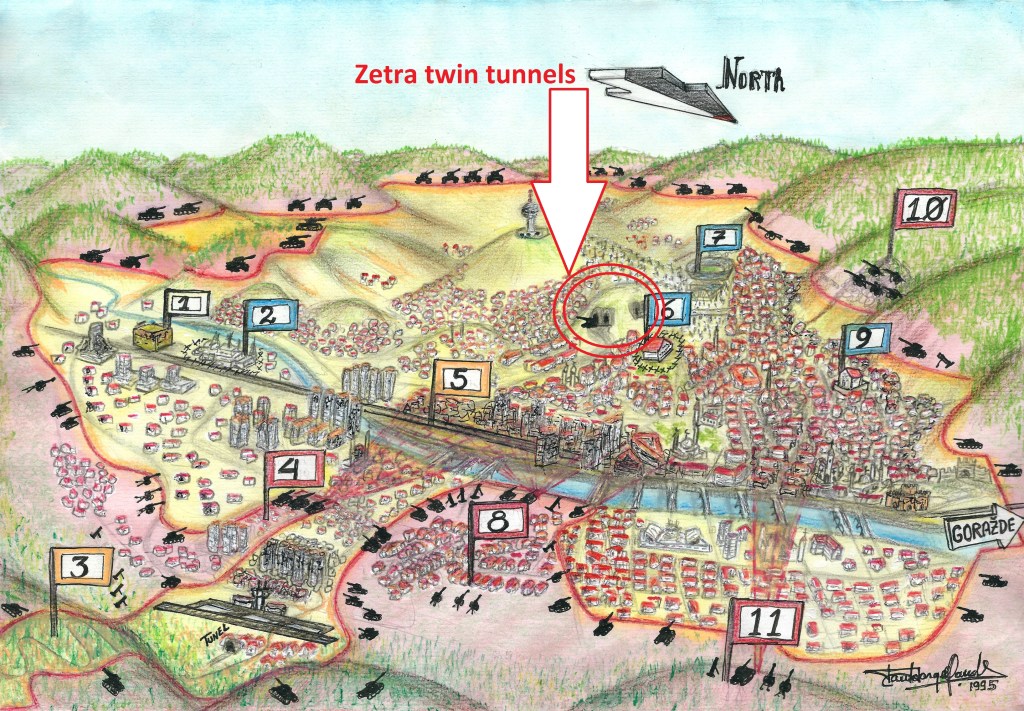
Those two tunnels also protected the locals from bad weather and they provided protection to setup small street markets inside. In truth, only one of the tunnels was fully dedicated for public use, because the other one, just a few meters away, only had a small portion dedicated to the population; the rest of the infrastructure was a shelter for ABiH warfare equipment. Locals used to say that the ABiH had four tanks in Sarajevo, and two of them were inside that tunnel. Regularly, the Bosnian soldiers would move one of the tanks to the opposite exit of the tunnel, facing the Serbian part of town, and fire its big weapon. After two or three rounds the tank would move back into the tunnel, remaining protected from Serbian retaliation fire.
 OPen samento