Historical Background:
In ancient times, many borders were not clearly defined lines, but rather fortified neutral zones called Marchlands – or Marzbān in Old Persian (frontier protector) – where tribal allegiances to emperors defended the core territory of the Empire from rival powers. Such was the case of Marzbān Kabul – Afghanistan – between the 3rd and 7th centuries AD.
In the 19th Century AD, when the British Empire ruled over the Indian Subcontinent, Afghanistan was considered as an independent princely state, although the British controlled its foreign affairs and diplomatic relations. Nevertheless, Afghanistan was still seen as a buffer territory, between the Russian Empire and the British interests in the region, preventing the Russians to have access to the Indian Ocean. After the 1813 Russian-Persian Treaty, the British concerns of a possible Russian invasion of India, through Afghanistan, intensified and the strategic rivalry between the two Empires, over Central Asia, became known as “The Great Game”. The British tried an alliance with the Afghans against the Russian intentions, but failed, leading to the British military incursions of Afghan in 1839 and again in 1878. In each of these two Anglo-Afghan Wars, the British Army was completely annihilated by the Afghan tribal militias. Following the second Anglo-Afghan war, the Treaty of Gandamak was signed, ceding control of various frontier areas to the Afghan King and the British Empire. The British would pay a yearly amount of money (six lakhs of rupees) to Afghanistan but would retain the Afghan foreigner affairs in British domain. However, the east/southeast border between Afghanistan and the British India was not properly defined and, in 1893, a border agreement was signed between the two countries, known as the Durand Line.
The Durand Line:
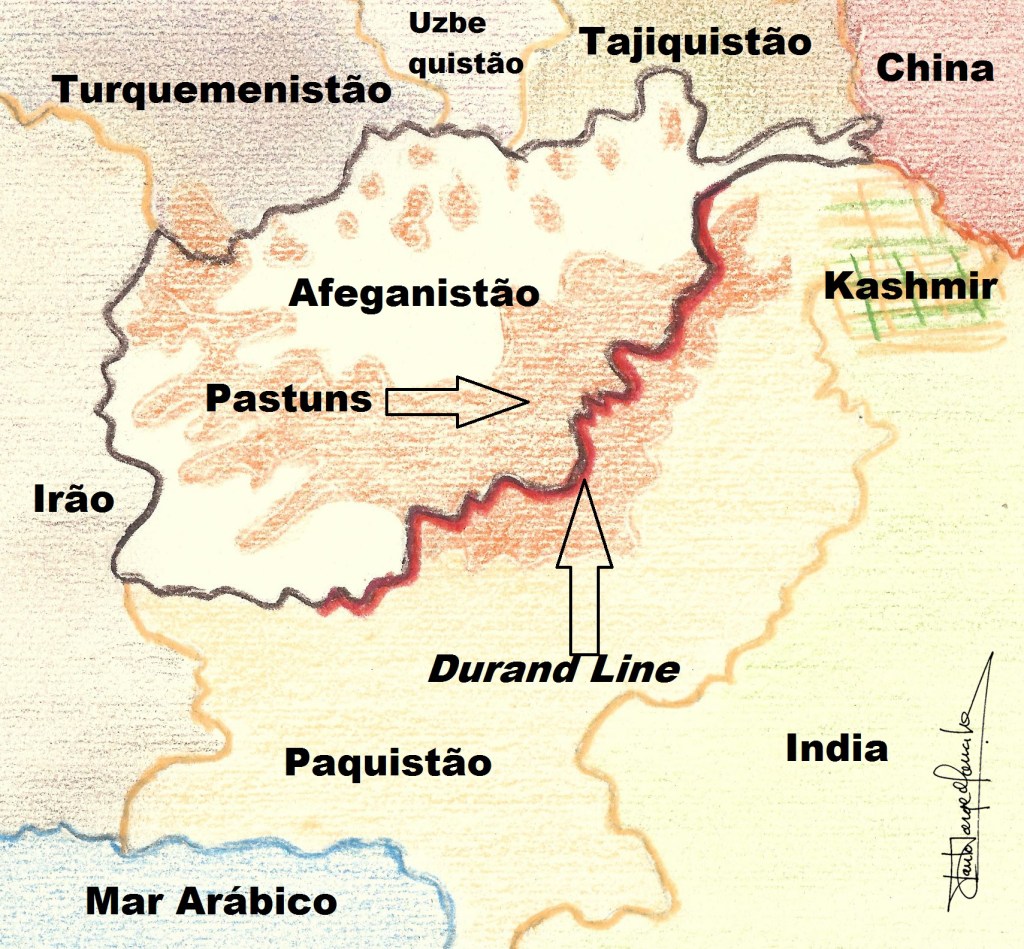
The Durand Line is a 2,640 kilometers (1,640 mi) long frontier agreement, signed in Kabul in 2 November 1893, between the Afghan monarch – Emir Abdurrahman Khan – and the Foreign Secretary of British India – Mortimer Durand – fixing the limit of the Afghan and British-India spheres of influence. The Line was designed by Mortimer Durand, without considering the ethnographic reality on the ground, cutting through Pashtun tribal areas and, further south, through the Baluchistan region. After its signature, a joint British-Afghan demarcation survey took place, but only managed to cover less than one third of the boundary, due to security problems resulting from local tribal unacceptance of the border.
The Afghan kings, have always refused to accept the Durand Line as an international border, rather a cease fire or military separation line, claiming their previous territory that used to extend until the Indus River. In 1919 Afghanistan took the initiative to retake the lost territories of Quetta and Peshawar, beyond the Durand Line, starting the Third Anglo-Afghan War. The result of this war was yet another treaty between the Emirate of Afghanistan and the British-India; sign in 8 August in Rawalpindi, where the Durand Line was reaffirmed, as the political boundary between the two countries, and the Afghans received the right to manage their own foreigner affairs business, hence gaining their full independence.
The Durand Line was slightly modified by the 1919 Anglo-Afghan Rawalpindi Treaty and subsequently inherited by Pakistan, following its independence in 1947, becoming the modern border between Pakistan and Afghanistan, although the latest does not officially recognizes it as an International Border. In the mid-20th century the area on both sides of the line became the subject of a movement for Pashtun independence and establishment of an independent state of Pakhtunistan. In 1980 approximately 7.5 million Pashtuns were living in the area around the Durand Line. Several sources claim that the Durand Line’s agreement was meant to be in force during 100 years and that it has expired in 1993. However, that information is not mentioned in the (English version) of the agreement.
Why don’t the Afghans recognize the Durand Line as an International Border?
The Durand Line is probably one of the most problematic issues in Afghan’s political arena. For the Afghan authorities, and intellectuals, the Durand Line is an agreement for limitation of military operations, signed between the British-India and Afghanistan. It is neither a Treaty nor an International Border establishment; and, above all, it should not be valid for the subsequently formed Pakistani State.
- It is not a Treaty because it has not been subjected to bilateral negotiations and it did not respect the several judicial procedures that regulate such pacts. Rather it was a unilaterally imposed document, by an overwhelming power over far less power and week regime, without even having been translated to into the language the Afghan Monarch could understand;
- It is not an International Border establishment, because the Afghan party has never agreed with such a definition; and, although the Afghan Border Police does respect the line on the maps to exercise their mandate, there are no border demarcation signs on the ground to guide the local population;
- It should not be applicable to the Afghan/Pakistani reality, because, being a military operation’s separation line, it was meant to be applied to two different armies in a completely different world order and, like in any contract, if one of the parts resigns the agreement (Afghanistan) the document is not valid and another version has got to be negotiated.
The Pashtun ethnicity, a culture that has the upmost respect for tribal and family bonds, was artificially divided by the Durand Line. However, over the past 118 years these ties did not fade way, by the contrary, the line was never a respected as a separation or impediment for (cross border) marriages, family visits, and tribal agreements or businesses. In both sides of the line, the respective governments have little influence over the local communities, and the tribal customs rule the daily live. Pakhtunistan (the land of the Pashtuns in both side of the line) became the major controversy regarding the Afghan’s external relations with Pakistan.
Another discussion point is the absence of Baluchistan in the agreement. At the time the Durand Line was signed, Baluchistan was also considered an independent princely state, with its own sovereign government. However, Baluchistan was not heard or signed any agreement regarding the division of the country. Therefore, for the Durand Line to be considered an international Border, it would have to be a tripartite (not bilateral) treaty, which was not the case.
According to Aimal Faizi, spokesman for the Afghan President (2014), the Durand Line is “an issue of historical importance for Afghanistan. The Afghan people, not the government, can take a final decision on it.” This opens the space for a potential referendum type public consultation. However, should that be the case, and taken into consideration the trans-border tribal issue, what would be questions asked for the people to choose? Accept the Durand Line as an international border (yes or no?). However, if the answer would “no”, what then?
The Pakistani position
On 09 October 1974, during the 2283th plenary meeting of the UN General Assembly, the Pakistani Representative at the United Nations, referred to the Durand Line as the border between Afghanistan and Pakistan and that Afghanistan had claims over certain parts of he Pakistani Territory (referring to Pakhtunistan). He further informed that at the time of emergence of Pakistan as an independent and sovereign state, a referendum was held and the population decided to become Pakistani citizens.
According to Pakistani officials, the Durand Line is fully recognized as the official border between Pakistan and Afghanistan, such as it is for the international community. The problem resides in Afghanistan, which appears to be interested in expanding its territory towards Pakistan.
Why is it so important to recognize an official International Border?
The Pakistani based insurgency, operating inside Afghanistan, enjoys all sort of support from the “other side” of the Durand Line, enabling them to carry on, year after year, their military campaigns in Afghanistan. The same concept applies for the Pakistani Taliban, which are using Afghan territory as a safe haven for their actions in Pakistan. Should an International Border be officially recognized by both Afghanistan and Pakistan, with joint or coordinated border patrol/control forces, hence stopping unilateral military actions against the respective insurgent threat across the Durand Line (cross border shelling).
Illegal trafficking of all sort of products would gradually diminish, giving place to a proper, much needed, border customs activities and taxation. Up to $7 billion of Pakistan produce is thought to be smuggled illegally into Afghanistan each year. Implementing a proper border and customs control in Afghanistan would have a positive impact on a Regional scale.
Conclusion – From a geopolitical perspective, the Durand Line has been described as one of the most dangerous borders in the World. With more than seven million Pashtuns living in both sides of the line, any solution will necessarily have to take into consideration the cross border cultural and family ties. The solution would seem to be the official recognition of “Soft Border” status, enabling the population to continue its daily border crossing, while maintaining a tight observance on customs and security issues. However, a “Soft Border” solution will require that both Afghanistan and Pakistan would have to have a proper control of their own territories, which presently is certainly not the case.
 OPen samento