A certain day, in 2013, at the United Nations civilian compound in Afghanistan’s Central Highlands – Bamyan – there was a rumor that someone was going to conduct an old style Christian catholic mass, somewhere down town.

The invitation came in a closed door environment, with a whispering voice, as if it was “classified information”. In fact, the subject deserved such precautions because that was the “Islamic Republic of Afghanistan”, where the official practice of other religions was not permitted.
– “A Christian mass? Here? Isn´t that illegal? – I asked surprised.
– “Shush!” – Imposed my interlocutor. – “You want to come or not?”
– “Off course I want to come! When do we leave?” – I answered, expecting yet another afghani adventure.
– “We leave at sun-set. Make sure you don’t wear a military uniform.”
In Afghanistan, the only place officially authorized to conduct a Christian Mass was the chapel inside the Italian Embassy. The reason for that exception was because Italy was the very first country to recognize Afghanistan’s independence, in 1919. In thankfulness of Italy’s recognition, the Afghani King – Amanullah Khan – asked Rome what they would like to receive as a token of appreciation. That was a delicate question; it would have to be accepted – otherwise it would offend the King – and it would have to be symbolic. It would also have to bring some sort of special primacy to the Italian Embassy in Kabul, regarding the rest of the international diplomatic corps. Therefore, the Italian Government asked permission to conduct (officially) Christian Catholic Mass inside their Embassy’s perimeter, and that the Mass could have the audience of other people beyond the Italian community. The request was accepted as an exceptional measure, and all the international staff started to go on Sundays to the Italian Embassy. Even during the Taliban hardliner domination that ceremony was exceptionally permitted.
Bamyan region is inhabited by the Hazara ethnic group (descendants of Genghis Khan’s Mongols), which are known to be very friendly and permissible to westerns’ attitudes. Nevertheless, it was not a good idea to abuse one’s luck, and the entire subject was handled in confidentiality. It felt like the medieval Roman times, when the first Christian believers started their cult.
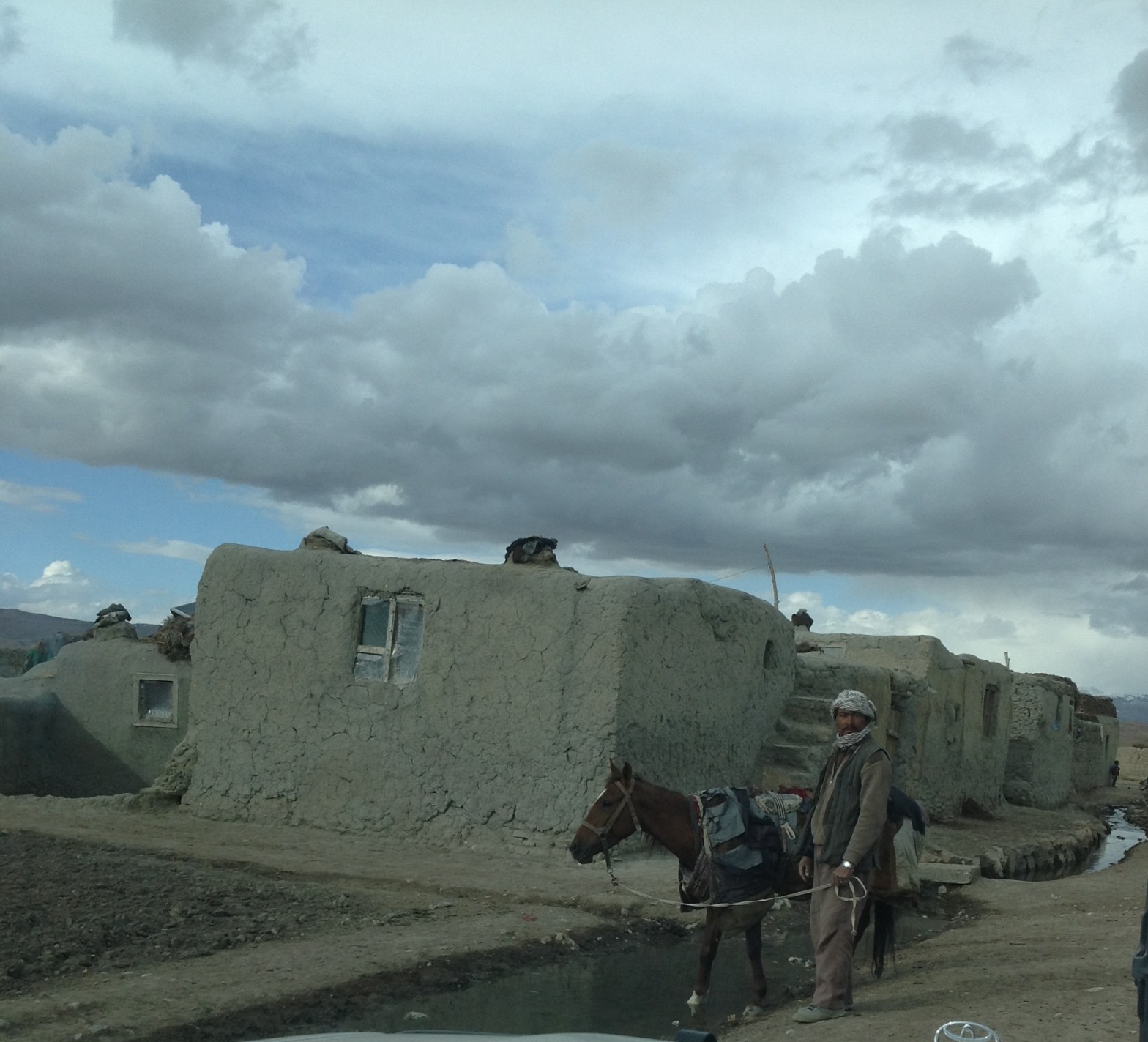
When twilight descended over Bamyan, a small group of five left the UNAMA compound, in a vehicle, without fuss. We carried a basket with dinner for ten, denouncing we were not going to have an evening picnic just for us. Closer to our destination, we parked the vehicle inside the premises of a friendly NGO, and continued on foot to our terminus. We moved silently, among the narrow streets of mud-bricks walls, trying not to stumble in the irregular pavement covered with snow patches. The moon had difficulty to show us where to go, and occasionally we had to use a flash light to find our way. It was cold; hence we were all wearing our Afghani blankets – “Patu” – which increased the medieval environment of our quest. The only sound was a distant dog, barking to denounce some wild animal that had descended from the surrounding mountains to heat on Bamyan’s garbage.
Our silence was broken when we arrived at a large gate, and gently announced our presence at the door. There were no passwords or special signs, we were expected and we couldn’t full any one; it was obvious what we had come for.
– “Good evening.” – Said the man inside the gate, in perfect English. – “Please come in; Father Andrew is waiting for you.”
Father Andrew was a Jesuit missioner, working on humanitarian support in Bamyan region. There were several Jesuit missioners in the house, constituting a nucleus of their order for that region. The Jesuits had traditions in Afghanistan, from the XVI Century. It all started with a small group headed by the Portuguese missioner Bento de Gois (1581) who practice his religion in Western Asia (no days Afghanistan). However, Father Andrew and the rest of his (2013) Jesuits were from the Philippines.
We crossed the large yard and, upon arriving at the house, we took off our shoes and delivered the food to another employee, which received us with an ample “Assalam-u-Aleikum” (may the peace be with you) placing his right hand over his heart while smiling at us. That was a gesture of truthfulness and hospitality.
The fragile electric light was coming from a (conveniently) noise generator, just outside the window. No one outside the house could really hear what was being said inside those walls, due to that generator. Three Jesuits and two afghan employees awaited the UN staff. After the fulfilling the arriving protocol of greetings, everybody set down over wide pillows on the floor, which covered with exquisite Persian carpets, and tea was served.
Some moments after, the employees received an eye signal from one of the Jesuits, and left the room. Father Andrew started to explain the ceremony that was going to occur, it was going to follow the old style service, were the scriptures were supposed to be “interpreted” by the audience, rather than simply read/announced by Jesus’ minister. He then invited the group to follow him.
Behind a curtain there was a low door, giving access to the basement´s stairs. At the basement, the other two Jesuits dragged away a closet revealing yet another entrance to a dark place. That hall in the wall was no more than 1,5 meters high and 90 centimeters wide. A narrow entrance to a dark room without any windows. That was the “Temple”. Father Andrew entered first and lighted several candles, in order for the rest of the people to see their way in. The reduce dimensions of the “door” forced the audience to enter one-by-one, with a deep bow. Inside the temple, it looked like an igloo. The room had been excavated on the sandy rock, with no more than nine square meters, with wall niches instead of windows, and a ceiling dome denouncing the help of mother nature in the construction of the Temple. Ceiling and walls were all painted in white, there were aromatic candles lighted on the niches, and the floor was completely covered with beautiful Persian carpets and large pillows. Opposite to the entrance there was a low table, which was used as the Temple’s Altar. Everybody set and the closet was pushed back to its original place, sealing the entrance, by the afghan employees.
The ritual started, in English, with the reading of the Bible. At a certain moment, Father Andrew stopped and assigned to each one on the audience the role of a character in the scene he had just read. It was time to interpret the Bible. After a meditation moment about each one’s character on the scene, everybody expressed what his/hers interpretation and feelings. That was no more a normal Mass; it was an “Anonymous Christian Gathering”.
–“Hello; my name is Judas and today I have sinned.”
It was intense!
The liturgy ended with the regular ceremonial acts, upon which we all returned up to the ground floor and had dinner, very much alike the Last Supper scene, both on the layout and the ritual.
That must have been one of the most enriching experiences I have in Afghanistan. It was just like time travel, back to the Roman Empire. The first Christians also had to conduct their ceremonies in a clandestine way, with secrecy, in reduced groups, inside small caves under the night’s shadowed protection.
 OPen samento