The news media’s job is to report the news. News can be defined as something that makes today different from yesterday. With that definition in mind, nearly every issue with which the military are involved is newsworthy; especially if the battle rhythm is slower than the news broadcast needs; which is normally the case.
The new security environment obliges political/military answers that rely on multi-national forces, coming from a myriad of different cultural and social realities. The principles of democracy dictate that governments maintain the support and confidence of their population. This necessitates a free, honest flow of information. This access to information often conflicts with the need of security in military operations. In the other hand, it fits perfectly in having the “sending Nations” living rooms during TV prime time and the political offices (back home) satisfied with the development of “our brave boys and girls at the front line”. Commanders and their staffs, at all levels, must consider these requirements in all types of operations; being in peacetime, in crisis or in open conflict.
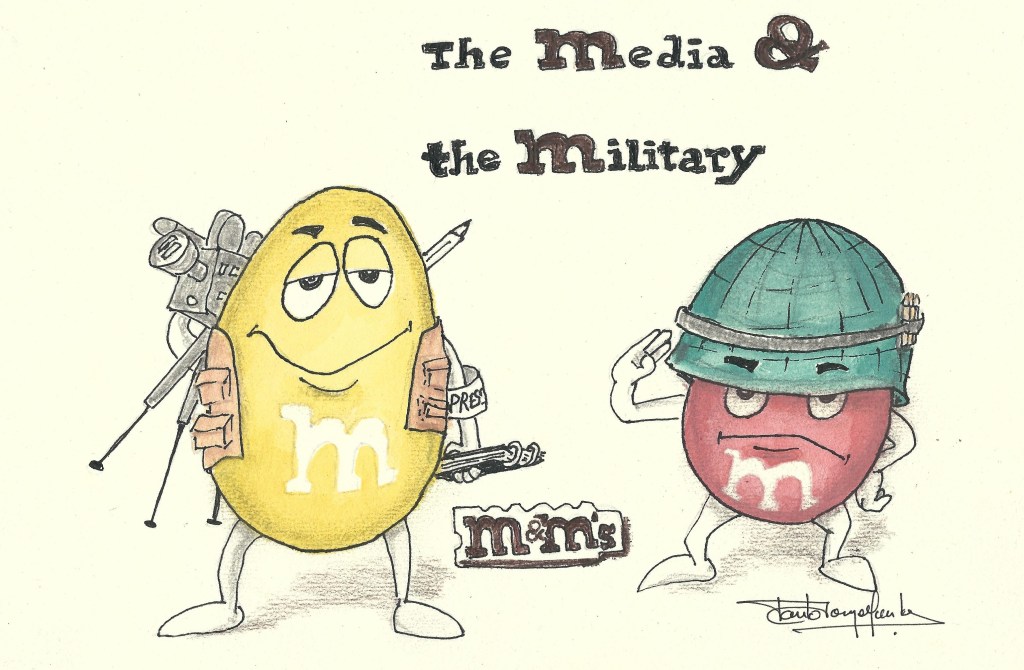
Having the Command and Control of a multinational force also means the Concern and Constrain of a multinational media interest. The Force Commander must anticipate such interest, and consider it as a part of the operations’ planning process.
The operational management of multinational contingents requires structural changes to the customary single nation operation, which, in turn, will require a changed approach to traditional Public Information (PI) functions. While PI operations in a multinational force are decentralized, their success depends on unity of effort. All levels of command must work towards common goals following common guidance. If proper measures are put in place ahead of developments, the Military and the Media can operate in sync, but there should be no space for the temptation to interfere in each other’s work sphere.
“In a Military Operation, the Media and the Military are like a railway track; they work close to each other, in the same direction, BUT in a parallel way and independently. If one of the parts tries to change that, the entire Operation (the train) will derail”.
And just when we all thought we (M&M) had it right … up came the social media platforms; where both “M” reside inside the same person. Any soldier with a mobile phone can become a front line news correspondent, showing the guys back home how cool he/she looks in combat fatigue, or crying for mom’s help (live) when under fire in a Taliban ambush. Yet another issue for the Commander’s concern: Where and when to apply censorship procedures? Restrictions on broadcasting (jammers)? Prohibition of certain devises? Etc.
Regardless the solution, in today’s world Strategic Communications is a mandatory component of any military operation’s planning. Because, like the psychotherapist, psychoanalytic, sociologist, philosopher and author Paul Watzlawick (1950s) used to say:
“One cannot, not communicate.”
 OPen samento